TheFastFashion.com Fashion, Life Style, Beauty, Makeup, Costume…

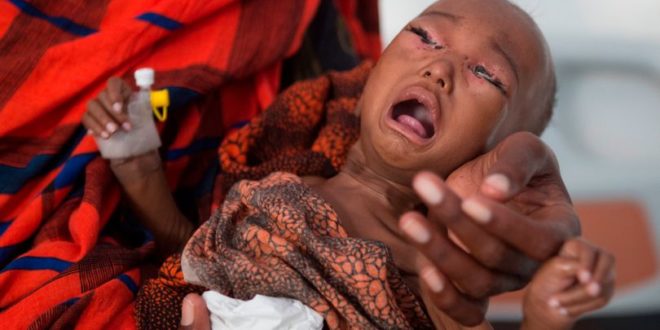
Six-month-old Hamdi weighs less than 8lbs – the average for a newborn in Britain – is hungry, in pain and looks ready to die
It is the stick-thin wrists that first mark out severely malnourished children like Hamdi Ahmed in drought-stricken Somalia.
At a clinic where dozens of desperately-ill babies are being brought in for emergency treatment, the skeletal girl lies listlessly in her mum Ayaan’s arms. Six months old but weighing less than 8lb – the average for a newborn in Britain – she shifts her head slowly towards me.
Only then do I see it is covered in white blotches, her mouth is red with a sore rash, and her eyes are painfully sealed over.
Hamdi is so hungry her body’s defence system has failed, leaving her prone to infection. She looks ready to die.
After three years without rain, the longest dry spell since records began here in 1950, Somalia is on the cusp of a devastating famine.

Death stalks the parched plains of the blighted Horn of Africa, picking off children one by one.
“She is so malnourished her immunity has gone,” says Dr Said Hamed. “Many children die of other complications as well as hunger.
“She has been in so much pain for three months she cannot eat. Her mother cannot breastfeed as she is not eating enough.”
Hamdi is just one of more than 20 million people afflicted by an unprecedented food crisis across four countries, Somalia, South Sudan, Nigeria and Yemen.

Hamdi’s malnourished mother cannot breastfeed because she is not eating enough to make milk (Photo: Andy Stenning/Daily Mirror)

In Somalia, a nation ruined by civil war and terrorist group al-Shabaab, the drought has wiped out 60% of the livestock on which most depend. Around 6.2 million people – more than half the population – are in dire need of assistance.
Latest surveys show 363,000 vulnerable children suffering from malnutrition, including 71,000 severe cases like Hamdi.
Without cattle and goats to trade for other foods such as rice and flour, families like hers living in the rocky red-sand desert have nothing.
So drastic are conditions that when a brief shower fell over one coastal region in December last year, 30,000 nomads marched off in the hope of saving their vital herds.
They left their wives and children to fend for themselves in makeshift camps. Fadumo was lucky enough to make it to this clinic in Garowe, the only one for 200 miles in any direction.

Alongside Hamdi in the ward is 18-month-old Ahmed, who was brought here unconscious four days before by his mother Asha Salah, 25.
At six kilos, just under one stone and less than half normal body weight, he is being fed through an intravenous drip on his wrist. He had severe anaemia and hypoglycaemia when he arrived.
Asha tells me: “He was so weak he couldn’t eat even if we had food to give him. He has been getting more and more ill for two months.
“For now he seems to be getting slowly better, but we live in a camp three hours from here. There I don’t know how we will get food as all of our goats have died. We used to have 400.”